H.G. Wells
Epilogue
One cannot choose but wonder. Will he ever return? It may be that he swept back into the past, and fell among the blood-drinking, hairy savages of the Age of Unpolished Stone; into the abysses of the Cretaceous Sea; or among the grotesque saurians, the huge reptilian brutes of the Jurassic times. He may even now - if I may use the phrase - be wandering on some plesiosaurus-haunted Oolitic coral reef, or beside the lonely saline lakes of the Triassic Age. Or did he go forward, into one of the nearer ages, in which men are still men, but with the riddles of our own time answered and its wearisome problems solved? Into the manhood of the race: for I, for my own part cannot think that these latter days of weak experiment, fragmentary theory, and mutual discord are indeed man's culminating time! I say, for my own part. He, I know - for the question had been discussed among us long before the Time Machine was made - thought but cheerlessly of the Advancement of Mankind, and saw in the growing pile of civilization only a foolish heaping that must inevitably fall back upon and destroy its makers in the end. If that is so, it remains for us to live as though it were not so. But to me the future is still black and blank - is a vast ignorance, lit at a few casual places by the memory of his story. And I have by me, for my comfort, two strange white flowers - shrivelled now, and brown and flat and brittle - to witness that even when mind and strength had gone, gratitude and a mutual tenderness still lived on in the heart of man.
Se afișează postările cu eticheta novel. Afișați toate postările
Se afișează postările cu eticheta novel. Afișați toate postările
sâmbătă, 21 martie 2009


joi, 12 martie 2009
Black Anggie
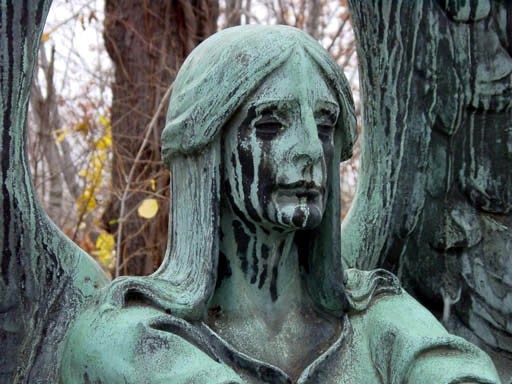
by S. E. Schlosser
When Felix Agnus put up the life-sized shrouded bronze statue of a grieving angel, seated on a pedestal, in the Agnus family plot in the Druid Ridge Cemetery, he had no idea what he had started. The statue was a rather eerie figure by day, frozen in a moment of grief and terrible pain. At night, the figure was almost unbelievably creepy; the shroud over its head obscuring the face until you were up close to it. There was a living air about the grieving angel, as if its arms could really reach out and grab you if you weren't careful.
It didn't take long for rumors to sweep through the town and surrounding countryside. They said that the statue - nicknamed Black Aggie - was haunted by the spirit of a mistreated wife who lay beneath her feet. The statue's eyes would glow red at the stroke of midnight, and any living person who returned the statues gaze would instantly be struck blind. Any pregnant woman who passed through her shadow would miscarry. If you sat on her lap at night, the statue would come to life and crush you to death in her dark embrace. If you spoke Black Aggie's name three times at midnight in front of a dark mirror, the evil angel would appear and pull you down to hell. They also said that spirits of the dead would rise from their graves on dark nights to gather around the statue at night.
People began visiting the cemetery just to see the statue, and it was then that the local fraternity decided to make the statue of Grief part of their initiation rites. "Black Aggie" sitting, where candidates for membership had to spend the night crouched beneath the statue with their backs to the grave of General Agnus, became popular.
One dark night, two fraternity members accompanied new hopeful to the cemetery and watched while he took his place underneath the creepy statue. The clouds had obscured the moon that night, and the whole area surrounding the dark statue was filled with a sense of anger and malice. It felt as if a storm were brewing in that part of the cemetery, and to their chagrin, the two fraternity members noticed that gray shadows seemed to be clustering around the body of the frightened fraternity candidate crouching in front of the statue.
What had been a funny initiation rite suddenly took on an air of danger. One of the fraternity brothers stepped forward in alarm to call out to the initiate. As he did, the statue above the boy stirred ominously. The two fraternity brothers froze in shock as the shrouded head turned toward the new candidate. They saw the gleam of glowing red eyes beneath the concealing hood as the statue's arms reached out toward the cowering boy.
With shouts of alarm, the fraternity brothers leapt forward to rescue the new initiate. But it was too late. The initiate gave one horrified yell, and then his body disappeared into the embrace of the dark angel. The fraternity brothers skidded to a halt as the statue thoughtfully rested its glowing eyes upon them. With gasps of terror, the boys fled from the cemetery before the statue could grab them too.
Hearing the screams, a night watchman hurried to the Agnus plot. To his chagrin, he discovered the body of a young man lying at the foot of the statue. The young man had apparently died of fright.
The disruption caused by the statue grew so acute that the Agnus family finally donated it to the Smithsonian museum in Washington D.C.. The grieving angel sat for many years in storage there, never again to plague the citizens visiting the Druid Hill Park Cemetery.
sâmbătă, 7 martie 2009
Dancing with the devil

byS. E. Schlosser
The girl hurried through her schoolwork as fast as she could. It was the night of the high school dance, along about 70 years ago in the town of Kingsville, Texas. The girl was so excited about the dance. She had bought a brand new, sparkly red dress for the dance. She knew she looked smashing in it. It was going to be the best evening of her life.
Then her mother came in the house, looking pale and determined.
"You are not going to that dance," her mother said.
"But why?" the girl asked her mother.
"I've just been talking to the preacher. He says the dance is going to be for the devil. You are absolutely forbidden to go," her mother said.
The girl nodded as if she accepted her mother's words. But she was determined to go to the dance. As soon as her mother was busy, she put on her brand new red dress and ran down to the K.C. Hall where the dance was being held.
As soon as she walked into the room, all the guys turned to look at her. She was startled by all the attention. Normally, no one noticed her. Her mother sometimes accused her of being too awkward to get a boyfriend. But she was not awkward that night. The boys in her class were fighting with each other to dance with her.
Later, she broke away from the crowd and went to the table to get some punch to drink. She heard a sudden hush. The music stopped. When she turned, she saw a handsome man with jet black hair and clothes standing next to her.
"Dance with me," he said.
She managed to stammer a "yes", completely stunned by this gorgeous man. He led her out on the dance floor. The music sprang up at once. She found herself dancing better than she had ever danced before. They were the center of attention.
Then the man spun her around and around. She gasped for breath, trying to step out of the spin. But he spun her faster and faster. Her feet felt hot. The floor seemed to melt under her. He spun her even faster. She was spinning so fast that a cloud of dust flew up around them both so that they were hidden from the crowd.
When the dust settled, the girl was gone. The man in black bowed once to the crowd and disappeared. The devil had come to his party and he had spun the girl all the way to hell.
duminică, 1 martie 2009
Rapunzel

Rapunzel, Campanula rapunculus (rampion), a congener of the -common harebell. It has a long white spindle-shaped root which is eaten raw like a radish, and has a pleasant sweet flavour. Its leaves and young shootsare also used in salads - and so are the roots, sliced.
There was once a man and a woman who had long in vain wished for a child.At length the woman hoped that God was about to grant her desire. These people had a little window at the back of their house from which a splendid garden could be seen, which was full of the most beautiful flowers and herbs. It was,however, surrounded by a high wall, and no one dared to go into it because it belonged to an enchantress, who had great power and was dreaded by all the world. One day the woman was standing by this window and looking down into the garden, when she saw a bed which was planted with the most beautiful rampion(rapunzel), and it looked so fresh and green that she longed for it, and had the greatest desire to eat some. This desire increased every day, and as she knew that she could not get any of it, she quite pined away, and looked paleand miserable. Then her husband was alarmed, and asked, "What aileth thee,dear wife?" "Ah," she replied, "if I can't get some of the rampion, which is in the garden behind our house, to eat, I shall die." The man, who loved her,thought, "Sooner than let thy wife die, bring her some of the rampion thyself,let it cost thee what it will." In the twilight of evening, he clambered down over the wall into the garden of the enchantress, hastily clutched a hand ful of rampion, and took it to his wife. She at once made herself a salad of it,and ate it with much relish. She, however, liked it so much - so very much -that the next day she longed for it three times as much as before. If he was to have any rest, her husband must once more descend into the garden. In the gloom of evening, therefore, he let himself down again; but when he had clambered down the wall he was terribly afraid, for he saw the enchantress standing before him. "How canst thou dare," said she with angry look, "to descend into my garden and steal my rampion like a thief? Thou shalt sufferf or it!" "Ah," answered he, "let mercy take the place of justice, I only made up my mind to do it out of necessity. My wife saw your rampion from the window, and felt such a longing for it that she would have died if she had not got some to eat." Then the enchantress allowed her anger to be softened, and said to him, "If the case be as thou sayest, I will allow thee to take away with thee as much rampion as thou wilt, only I make one condition, thou must give me the child which thy wife will bring into the world; it shall be well treated, and I will care for it like a mother." The man in his terror consented to everything, and when the woman was brought to bed, the enchantress appeared at once, gave the child the name of Rapunzel, and took it away with her. Rapunzel grew into the most beautiful child beneath the sun. When she wastwelve years old, the enchantress shut her into a tower, which lay in a forest, and had neither stairs nor door, but quite at the top was a little window. When the enchantress wanted to go in, she placed herself beneath this and cried, "Rapunzel, Rapunzel,Let down thy hair to me." Rapunzel had magnificent long hair, fine as spun gold, and when she heard the voice of the enchantress she unfastened her braided tresses, wound them round one of the hooks of the window above, and then the hair fell twenty ells down,and the enchantress climbed up by it. After a year or two, it came to pass that the King's son rode through theforest and went by the tower. Then he heard a song, which was so charming that he stood still and listened. This was Rapunzel, who in her solitude passed her time in letting her sweet voice resound. The King's son wanted to climb up to her, and looked for the door of the tower, but none was to be found. He rode home, but the singing had so deeply touched his heart, that every day he went out into the forest and listened to it. Once when he was thus standing behind a tree, he saw that an enchantress came there, and he heard how she cried, "Rapunzel, Rapunzel,Let down thy hair." Then Rapunzel let down the braids of her hair, and the enchantress climbed upto her. "If that is the ladder by which one mounts, I will for once try my fortune," said he, and the next day when it began to grow dark, he went to the tower and cried, "Rapunzel, Rapunzel,Let down thy hair." Immediately the hair fell down and the King's son climbed up. At first Rapunzel was terribly frightened when a man such as her eyes had never yet beheld, came to her; but the King's son began to talk to her quite like a friend, and told her that his heart had been so stirred that it had let him have no rest, and he had been forced to see her. Then Rapunzel lost her fear, and when he asked her if she would take him for her husband, and she saw that he was young and handsome, she thought, "He will love me more than old Dame Gothel does;" and she said yes, and laid her hand in his. She said, "I will willingly go away with thee, but I do not know how to get down. Bring with thee a skein of silk every time that thou comest, and I will weave a ladder with it, and when that is ready I will descend, and thou wilt take meon thy horse." They agreed that until that time he should come to her every evening, for the old woman came by day. The enchantress remarked nothing of this, until once Rapunzel said to her, "Tell me, Dame Gothel, how it happens that you are so much heavier for me to draw up than the young King's son - heis with me in a moment." "Ah! thou wicked child," cried the enchantress, "What do I hear thee say! I thought I had separated thee from all the world, and yet thou hast deceived me!" In her anger she clutched Rapunzel's beautifultresses, wrapped them twice round her left hand, seized a pair of scissors with the right, and snip, snap, they were cut off, and the lovely braids lay on the ground. And she was so pitiless that she took poor Rapunzel into a desert where she had to live in great grief and misery. On the same day, however, that she cast out Rapunzel, the enchantress in the evening fastened the braids of hair which she had cut off to the hook of the window, and when the King's son came and cried, "Rapunzel, Rapunzel,Let down thy hair," she let the hair down. The King's son ascended, but he did not find his dearest Rapunzel above, but the enchantress, who gazed at him with wicked and venomous looks. "Aha!" she cried mockingly, "Thou wouldst fetch thy dearest,but the beautiful bird sits no longer singing in the nest; the cat has got it,and will scratch out thy eyes as well. Rapunzel is lost to thee; thou wilt never see her more." The King's son was beside himself with pain, and in his despair he leapt down from the tower. He escaped with his life, but the thorns into which he fell pierced his eyes. Then he wandered quite blind about the forest, ate nothing but roots and berries, and did nothing but lament and weepover the loss of his dearest wife. Thus he roamed about in misery for someyears, and at length came to the desert where Rapunzel, with the twins to which she had given birth, a boy and a girl, live in wretchedness. He heard a voice, and it seemed so familiar to him that he went towards it, and when he approached, Rapunzel knew him and fell on his neck and wept. Two of her tears wetted his eyes and they grew clear again, and he could see with them as before. He led her to his kingdom where he was joyfully received, and they lived for a long time afterwards, happy and contended.
sâmbătă, 28 februarie 2009
the wolf and the seven little kids
There was once upon a time an old goat who had seven little kids, and loved them with all the love of a mother for her children. One day she wanted to go into the forest and fetch some food. So she called all seven to her and said, "Dear children, I have to go into the forest, be on your guard against the wolf; if he comes in, he will devour you all - skin, hair and all. The wretch often disguises himself, but you will know him at once by his rough voice and his black feet." The kids said, "Dear mother, we will take good care of ourselves; you may go away without any anxiety." Then the old one bleated,and went on her way with an easy mind.
It was not long before someone knocked at the house-door and cried,"Open the door, dear children; your mother is here, and has brought something back with her for each of you." But the little kids knew that it was the wolf, by the rough voice; "We will not open the door," cried they, "thou art not our mother. She has a soft, pleasant voice, but thy voice is rough; thou art the wolf!" Then the wolf went away to a shop keeper and brought himself a great lump of chalk, ate this and made his voice soft with it. Then he came back,knocked at the door of the house, and cried, "Open the door, dear children,your mother is here and has brought something back with her for each of you."But the wolf had laid his black paws against the window, and the children saw them and cried, "We will not open the door, our mother has not black feet like thee: thou art the wolf!" Then the wolf ran to a baker and said, "I have hurt my feet, rub some dough over them for me." And when the baker had rubbed his feet over, he ran to the miller and said, "Strew some white meal over my feet for me." The miller thought to himself, "The wolf wants to deceive some one,"and refused; but the wolf said, "If thou wilt not do it, I will devour thee."Then the miller was afraid, and made his paws white for him. Truly men are like that.
So now the wretch went for the third time to the house-door, knocked at it and said, "Open the door for me, children, your dear little mother has come home, and has brought every one of you something back from the forest with her." The little kids cried, "First show us thy paws that we may know if thou art our dear little mother." Then he put his paws in through the window, and when the kids saw that they were white, they believed that all he said was true, and opened the door. But who should come in but the wolf! They were terrified and wanted to hide themselves. One sprang under the table, the second into the bed, the third into the stove, the fourth into the kitchen,the fifth into the cup board, the sixth under the washing-bowl, and the seventh into the clock-case. But the wolf found them all, and used no great ceremony; one after the other he swallowed them down his throat. The youngest in the clock-case was the only one he did not find. When the wolf had satisfied his appetite he took himself off, laid himself down under a tree in the green meadow outside, and began to sleep. Soon afterwards the old goat came home again from the forest! Ah! what a sight she saw there! The house -door stood wide open. The table, chairs, and benches were thrown down, the washing-bowl lay broken to pieces, and the quilts and pillows were pulled off the bed. She sought her children, but they were nowhere to be found. She called them one after another by name, but no one answered. At last, when shecame to the youngest, a soft voice cried, "Dear mother, I am in the clock -case." She took the kid out, and it told her that the wolf had come and had eaten all the others. Then you may imagine how she wept over her poor children.
At length in her grief she went out, and the youngest kid ran with her.When they came to the meadow, there lay the wolf by the tree and snored soloud that the branches shook. She looked at him on every side and saw that something was moving and struggling in his gorged body. "Ah, heavens," said she, "is it possible that my poor children whom he has swallowed down for his supper, can be still alive?" Then the kid had to run home and fetch scissors,and a needle and thread, and the goat cut open the monster's stomach, and hardly had she made one cut, than one little kid thrust its head out, and when she had cut farther, all six sprang out one after another, and were all still alive, and had suffered no injury whatever, for in his greediness the monsterhad swallowed them down whole. What rejoicing there was! Then they embraced their dear mother, and jumped like a tailor at his wedding. The mother,however, said, "Now go and look for some big stones, and we will fill the wicked beast's stomach with them while he is still asleep." Then the seven kids dragged the stones with all speed, and put as many of them into his stomach as they could get in; and the mother sewed him up again in the greatest haste, so that he was not aware of anything and never once stirred.
When the wolf at length had had his sleep out, he got on his legs, and as the stones in his stomach made him very thirsty, he wanted to go to a well todrink. But when he began to walk and to move about, the stones in his stomach knocked against each other and rattled. Then cried he, "What rumbles and tumbles Against my poor bones?I thought 'twas six kids,But it's naught but big stones."
And when he got to the well and stooped over the water and was just about to drink, the heavy stones made him fall in and there was no help, but he had to drown miserably. When the seven kids saw that, they came running to the spot and cried aloud, "The wolf is dead! The wolf is dead!" and danced for joy round about the well with their mother.
vineri, 20 februarie 2009
Alchimistul
PROLOG
Alchimistul luă o carte pe care o adusese cineva din caravană. Tomul era fără copertă, dar reuşi să-i identifice autorul: Oscar Wilde. În timp ce-i răsfoia paginile, găsi o povestire despre Narcis.
Alchimistul cunoştea legenda lui Narcis, frumosul băiat care-şi contempla zilnic propria frumuseţe într-un lac. Era atît de fascinat de el însuşi că într-o bună zi a căzut în lac şi a murit înecat. În locul acela, a apărut o floare care s-a numit narcisă.
Dar nu aşa îşi încheia Oscar Wilde povestirea. El spunea că atunci cînd a murit Narcis, au venit
naiadele ― zeiţele izvoarelor şi ale pădurii ― şi au văzut lacul transformat dintr-unul cu apă dulce, într-un ulcior cu lacrimi sărate.
― De ce plîngi? au întrebat naiadele.
― Plîng pentru Narcis, răspunse lacul.
― Ah, nu-i de mirare că plîngi pentru Narcis, continuară ele. La urma urmelor, deşi noi am alergat mereu după el prin pădure, tu erai singurul care puteai să-i contempli de aproape frumuseţea.
― Dar Narcis era frumos? întrebă lacul.
― Cine altul poate şti mai bine decît tine? răspunseră, surprinse, naiadele. La urma urmelor, doar pe marginile tale se apleca el în fiecare zi.
Lacul rămase tăcut o vreme. Într-un tîrziu, zise:
― Îl plîng pe Narcis, dar niciodată n-am ştiut că el era frumos. Îl plîng pe Narcis pentru că de fiecare dată cînd se apleca deasupra apelor mele, eu puteam să văd reflectată, în fundul ochilor lui, propria-mi frumuseţe.
"Ce povestire frumoasă", spuse Alchimistul.
Zdrentulita

basm englez
Intr-un maret palat, la malul marii, traia odata un lord batran si foarte bogat, care nu avea nici sotie nici copii in viata, avea doar o nepotica al carei chip nu-l vazuse niciodata. Batranul isi ura nepotica caci la nasterea ei, ii murise cea mai draga dintre fiice. Cand batrana doica ii adusese copila, el se jura ca, atat cat va trai, nu se va uita la ea, nu avea decat sa traiasca sau sa moara, lui nu-i pasa.Asa ca-i intoarse spatele, se aseza la fereastra si privi peste intinderea nesfarsita a marii, varsand lacrimi amare dupa fiica lui care se prapadise, pana cand parul sau coliliu si barba carunta ii crescura mult peste umeri, se incolacira peste speteaza scaunului sau si patrunsera prin crapaturile din dusumea. Lacrimile sale, care picurau pe pervazul geamului, sapasera un sant in piatra si curgeau ca un raulet in mare.In tot acest timp, nepoata lui crescu fara ca cineva sa-i poarte de grija. Doar doica cea batrana se mai indura de ea si, cand nu era nimeni prin preajma, ii dadea ceva resturi de la bucatarie sau cate o rochita rupta luata din sacul cu zdrente.Ceilalti servitori de la palat o alungau cu lovituri si cuvinte de ocara poreclind-o Zdrentuita si aratau cu degetul spre picioarele ei desculte si umerii golasi. Si asa crescu ea, mai mult nemancand si imbracandu-se cu te miri ce, petrecandu-si zilele prin campuri si pe carari. Singurul ei tovaras era gascarul care, atunci cand ei ii era foame sau frig sau era obosita, ii canta atat de vesel din fluier, incat ea-si uita de necazuri si se pornea sa danseze cu galagioasele gaste.Asta pana intr-o zi cand oamenii prinsera a susoti cum ca regele facea o calatorie in tinutul lor si ca intentiona sa dea un mare bal in orasul invecinat pentru toti domnii si domnitele din tinut la care printul, unicul sau fiu, urma sa-si aleaga nevasta.O astfel de invitatie sosi si la palatul de pe malul marii si servitorii o dusera batranului lord, care inca mai sedea la fereastra, varsand lacrimi amare. Dar, cand auzi despre ce era vorba, isi zvanta lacrimile si ordona sa i se aduca foarfeci cu care-si taie pletele lungi si barba, apoi trimise sa-i aduca haine scumpe si bijuterii si se imbraca. Ordona sa se puna seaua de aur pe calul cel alb, ca sa poata iesi in intampinarea regelui.Zdrentuita auzise si ea vestea si se aseza in usa bucatariei plangand ca nu poate sa-l vada si ea pe rege. Cand batrana doica o vazu asa, se duse la stapan si-l ruga s-o ia si pe nepoata lui cu el la balul regelui. Dar acesta s-a incruntat si i-a zis ca nu vrea sa auda de fata. Auzind asta, Zdrentuita fugi sa-i povesteasca prietenului ei gascarul cat e de nefericita ca nu poate merge la bal. Gascarul o asculta apoi ii propuse sa mearga impreuna in oras sa-l vada pe rege. Ea a privit insa cu tristete la picioarele-i desculte si hainele zdrentuite. Vazand-o gascarul a scos fluierasul si a inceput sa cante, iar fata imediat s-a veselit. Baiatul a luat-o de mana si, cu gastele deschizandu-le drumul, au pornit spre oras.N-au mers prea mult, cand un tanar chipes, imbracat frumos, veni calare spre ei ca sa-i intrebe incotro s-o ia ca sa ajunga la castelul unde se oprise regele. Cand afla ca si cei doi merg tot acolo, descaleca si merse alaturi de ei tot drumul. Gascarul isi scoase fluierul si canta o melodie duioasa. In acest timp, tanarul tragea cu coada ochiului la fata pana ce se indragosti de ea. Isi lua inima in dinti si o ceru de nevasta.Dar Zdrentuita rase, zicandu-i ca i-ar sta tare bine cu o nevasta gascarita, apoi adauga ca el ar trebui sa-si ia nevasta una dintre domnitele pe care le va intalni la bal.Cu cat ea il refuza, cu atat tanarul o ruga mai aprins. In cele din urma, ca s-o convinga de sinceritatea sa, o implora sa vina la bal la ora douasprezece noaptea, asa cum era imbracata, desculta si impreuna cu prietenul ei gascarul si cu gastele acestuia.Cand se lasa noaptea si sala de bal era inundata de lumina si muzica, iar domnii si doamnele dansau in fata regelui, tocmai cand orologiul batea ora douasprezece, pe usile enorme intrara Zdrentuita si gascarul, urmati de cardul de gaste. Strabatura sala, in timp ce doamnele susoteau. domnii radeau, iar regele privea nedumerit.Dar cand ajunsera in fata tronului, tanarul se ridica de langa tronul regelui si veni in intampinarea lor. Luand-o de mana pe Zdrentuita se intoarse spre rege si-i spuse ca ea era mireasa aleasa de el, caci tanarul era chiar printul in cinstea caruia se dadea balul.Inainte sa termine ce avea de spus, gascarul duse fluierul la gura si incepu sa cante, iar in timp ce canta, hainele Zdrentuitei se transformau in vesminte stralucitoare, o coronita de aur era in parul ei, iar cardul de gaste se prefacuse intr-un alai de paji care-i duceau trena lunga.Toti cei din sala au remarcat ca printul isi alesese de nevasta pe cea mai frumoasa fata din tinut.Gascarul s-a facut nevazut si nimeni nu a mai auzit de el de atunci. Batranul lord s-a intors la palatul sau de pe malul marii, la curte nu putea ramane caci jurase ca nu-si va privi niciodata nepoata. Cred ca l-ati putea vedea, caci el tot mai sta langa fereastra, plangand amarnic si privind departe spre intinderea nesfarsita a marii.
Intr-un maret palat, la malul marii, traia odata un lord batran si foarte bogat, care nu avea nici sotie nici copii in viata, avea doar o nepotica al carei chip nu-l vazuse niciodata. Batranul isi ura nepotica caci la nasterea ei, ii murise cea mai draga dintre fiice. Cand batrana doica ii adusese copila, el se jura ca, atat cat va trai, nu se va uita la ea, nu avea decat sa traiasca sau sa moara, lui nu-i pasa.Asa ca-i intoarse spatele, se aseza la fereastra si privi peste intinderea nesfarsita a marii, varsand lacrimi amare dupa fiica lui care se prapadise, pana cand parul sau coliliu si barba carunta ii crescura mult peste umeri, se incolacira peste speteaza scaunului sau si patrunsera prin crapaturile din dusumea. Lacrimile sale, care picurau pe pervazul geamului, sapasera un sant in piatra si curgeau ca un raulet in mare.In tot acest timp, nepoata lui crescu fara ca cineva sa-i poarte de grija. Doar doica cea batrana se mai indura de ea si, cand nu era nimeni prin preajma, ii dadea ceva resturi de la bucatarie sau cate o rochita rupta luata din sacul cu zdrente.Ceilalti servitori de la palat o alungau cu lovituri si cuvinte de ocara poreclind-o Zdrentuita si aratau cu degetul spre picioarele ei desculte si umerii golasi. Si asa crescu ea, mai mult nemancand si imbracandu-se cu te miri ce, petrecandu-si zilele prin campuri si pe carari. Singurul ei tovaras era gascarul care, atunci cand ei ii era foame sau frig sau era obosita, ii canta atat de vesel din fluier, incat ea-si uita de necazuri si se pornea sa danseze cu galagioasele gaste.Asta pana intr-o zi cand oamenii prinsera a susoti cum ca regele facea o calatorie in tinutul lor si ca intentiona sa dea un mare bal in orasul invecinat pentru toti domnii si domnitele din tinut la care printul, unicul sau fiu, urma sa-si aleaga nevasta.O astfel de invitatie sosi si la palatul de pe malul marii si servitorii o dusera batranului lord, care inca mai sedea la fereastra, varsand lacrimi amare. Dar, cand auzi despre ce era vorba, isi zvanta lacrimile si ordona sa i se aduca foarfeci cu care-si taie pletele lungi si barba, apoi trimise sa-i aduca haine scumpe si bijuterii si se imbraca. Ordona sa se puna seaua de aur pe calul cel alb, ca sa poata iesi in intampinarea regelui.Zdrentuita auzise si ea vestea si se aseza in usa bucatariei plangand ca nu poate sa-l vada si ea pe rege. Cand batrana doica o vazu asa, se duse la stapan si-l ruga s-o ia si pe nepoata lui cu el la balul regelui. Dar acesta s-a incruntat si i-a zis ca nu vrea sa auda de fata. Auzind asta, Zdrentuita fugi sa-i povesteasca prietenului ei gascarul cat e de nefericita ca nu poate merge la bal. Gascarul o asculta apoi ii propuse sa mearga impreuna in oras sa-l vada pe rege. Ea a privit insa cu tristete la picioarele-i desculte si hainele zdrentuite. Vazand-o gascarul a scos fluierasul si a inceput sa cante, iar fata imediat s-a veselit. Baiatul a luat-o de mana si, cu gastele deschizandu-le drumul, au pornit spre oras.N-au mers prea mult, cand un tanar chipes, imbracat frumos, veni calare spre ei ca sa-i intrebe incotro s-o ia ca sa ajunga la castelul unde se oprise regele. Cand afla ca si cei doi merg tot acolo, descaleca si merse alaturi de ei tot drumul. Gascarul isi scoase fluierul si canta o melodie duioasa. In acest timp, tanarul tragea cu coada ochiului la fata pana ce se indragosti de ea. Isi lua inima in dinti si o ceru de nevasta.Dar Zdrentuita rase, zicandu-i ca i-ar sta tare bine cu o nevasta gascarita, apoi adauga ca el ar trebui sa-si ia nevasta una dintre domnitele pe care le va intalni la bal.Cu cat ea il refuza, cu atat tanarul o ruga mai aprins. In cele din urma, ca s-o convinga de sinceritatea sa, o implora sa vina la bal la ora douasprezece noaptea, asa cum era imbracata, desculta si impreuna cu prietenul ei gascarul si cu gastele acestuia.Cand se lasa noaptea si sala de bal era inundata de lumina si muzica, iar domnii si doamnele dansau in fata regelui, tocmai cand orologiul batea ora douasprezece, pe usile enorme intrara Zdrentuita si gascarul, urmati de cardul de gaste. Strabatura sala, in timp ce doamnele susoteau. domnii radeau, iar regele privea nedumerit.Dar cand ajunsera in fata tronului, tanarul se ridica de langa tronul regelui si veni in intampinarea lor. Luand-o de mana pe Zdrentuita se intoarse spre rege si-i spuse ca ea era mireasa aleasa de el, caci tanarul era chiar printul in cinstea caruia se dadea balul.Inainte sa termine ce avea de spus, gascarul duse fluierul la gura si incepu sa cante, iar in timp ce canta, hainele Zdrentuitei se transformau in vesminte stralucitoare, o coronita de aur era in parul ei, iar cardul de gaste se prefacuse intr-un alai de paji care-i duceau trena lunga.Toti cei din sala au remarcat ca printul isi alesese de nevasta pe cea mai frumoasa fata din tinut.Gascarul s-a facut nevazut si nimeni nu a mai auzit de el de atunci. Batranul lord s-a intors la palatul sau de pe malul marii, la curte nu putea ramane caci jurase ca nu-si va privi niciodata nepoata. Cred ca l-ati putea vedea, caci el tot mai sta langa fereastra, plangand amarnic si privind departe spre intinderea nesfarsita a marii.
duminică, 15 februarie 2009
N.B.
by: Joseph Hall
LIEUTENANT LUDWIG KREUSLER glanced hurriedly through the mail that had accumulated during the month that the X-8 had been away from base. At the bottom of the pile he found the letter he had been seeking and his eyes brightened. It was a fat letter, addressed in feminine handwriting, and its original postmark was Washington, D.C., U.S.A.
"His excellency will see you, sir." The orderly had entered quietly and stood at attention.
With a slightly impatient shrug the Lieutenant shoved the letters into his pocket and left the room.
He found Admiral Von Herpitz, the wizard of the sea, at his desk. As the young man entered the old Admiral rose and came forward. This unusual mark of favour somewhat embarrassed the young officer until the old man, placing both huge hands upon his shoulders, looked into his eyes.
"Excellent."
The one word conveyed a volume of praise, gratification. The old sea dog was known as a silent man. Censure was more frequent from him than applause.
The Lieutenant could find no word. The situation was for him embarrassing in the extreme. He, like Herpitz, was a man of actions, and words confused him.
"These English," the old Admiral spoke grimly, "we will teach them. Have you seen the reports? They are having quite a little panic in America also over the Seronica. Two hundred of the passengers lost were American."
A file of papers lay on the table. Kreusler ran through them hurriedly. The Berlin journals gave the sinking of the Seronica great headlines followed by columns of sheer joy. The London and Paris and some of the New York sheets called the exploit a crime and its perpetrators pirates. But they all gave it utter and undivided thought. The X-8 had become the horror craft of the world. Berlin figuratively carried her young commander on her shoulders. He found himself the hero of the hour.
"You have done well for the Fatherland," Von Herpitz repeated as the Lieutenant was going out.
In his own cabin Kreusler forgot the Seronica and the X-8. The fat letter with the Washington post-mark absorbed him.
Two years, ending with the outbreak of the great war, Kreusler had been naval attaché to the German embassy at Washington. He had been popular in the society of the American capital. He was highly educated, a profound scientist, an original thinker, and an adaptable and interesting dinner guest. Dorothy Washburn, the youngest daughter of the Senator from Oregon, had made her début in Washington during the second winter of Kreusler's presence there. The two had met. They were exact opposites; he tall, severe, blond, thoughtfully serious; she, small, dark, vivacious, bubbling with the joy of life. Love was inevitable.
The fat letter was engrossing. It breathed in every line and word and syllable the fine love this wonder woman gave him. One paragraph was most astounding. It read:
"To be near thee, loved one, I have arranged, through the gracious kindness of our friends, to come to Berlin as a nurse. Just when is as yet uncertain, but come I will, fear not, as quickly as may be. Dost long for me, to see me, dearest heart, as I for thee? Well, soon perhaps that may not be so far away. Couldst not thou arrange to be wounded -- only slightly, of course, my love -- so that I might attend thee?"
The letter ended with tender love messages and assurances of devotion. The last sheet bore a single word, "Over," and on the reverse side a woman's most important news, a postscript. This read:
"P.S. Arrangements have been completed. Everything is settled. Even my father has consented, knowing of my great love. I sail next week."
And then:
"N.B. The ship on which I sail is the Seronica."
sâmbătă, 7 februarie 2009
silence of the lambs

A serial murderer known only by a grotesquely apt nickname—Buffalo Bill—is stalking women. He has a purpose, but no one can fathom it, for the bodies are discovered in different states. Clarice Starling, a young trainee at the FBI Academy, is surprised to be summoned by Jack Crawford, chief of the Bureau’s Behavioral Science section. Her assignment: to interview Dr. Hannibal Lecter—Hannibal the Cannibal—who is kept under close watch in the Baltimore State Hospital for the Criminally Insane.
Dr. Lecter is a former psychiatrist with a grisly history, unusual tastes, and an intense curiosity about the darker corners of the mind. His intimate understanding of the killer and of Clarice herself form the core of The Silence of the Lambs—an ingenious, masterfully written book and an unforgettable classic of suspense fiction.
Dr. Lecter is a former psychiatrist with a grisly history, unusual tastes, and an intense curiosity about the darker corners of the mind. His intimate understanding of the killer and of Clarice herself form the core of The Silence of the Lambs—an ingenious, masterfully written book and an unforgettable classic of suspense fiction.
Hannibal
Seven years have passed since Dr. Hannibal Lecter escaped from custody, seven years since FBI Special Agent Clarice Starling interviewed him in a maximum security hospital for the criminally insane. The doctor is still at large, pursuing his own ineffable interests, savoring the scents, the essences of an unguarded world. But Starling has never forgotten her encounters with Dr. Lecter, and the metallic rasp of his seldom-used voice still sounds in her dreams.
Mason Verger remembers Dr. Lecter, too, and is obsessed with revenge. He was Dr. Lecter’s sixth victim, and he has survived to rule his own butcher’s empire. From his respirator, Verger monitors every twitch in his worldwide web. Soon he sees that to draw the doctor, he must have the most exquisite and innocent-appearing bait; he must have what Dr. Lecter likes best.
Powerful, hypnotic, utterly original, Hannibal is a dazzling feast for the imagination. Prepare to travel to hell and beyond as a master storyteller permanently alters the world you thought you knew

Abonați-vă la:
Postări (Atom)