okok, stiu ca n-am mai postat nimic de o groaza de timp, dar d-abia am avut timp sa mai respir si nici acum n-am terminat treaba. Sincera sa fiu n-am mai citit nimic decat ce mi-a trebuit pt scoala, deci....sa mai dau inainte de vacanta de Paste(pe care ,apropo o sa fiu nevoita sa mi-o iau singura :)) ) pe la biblioteca pt ceva haios. Nu de alta, dar urmeaza partialele si apoi imediat sesiunea si iar n-o sa mai am timp de nimic ... Oricum saptamana trecuta la un curs a iesit ditamai taraboiul cand le-am povestit al 2-lea rasarit de arthur c. clarke, parerile au fost impartite dar toti au refuzat sa se puna in situatia lor, cred ca ideea de baza la ei a fost ceva de genul: asa ceva nu ni s-ar intampla noua, nu e nici o legatura. Am fost singura impotriva tuturor :)) , se pare ca nu sunt multi cei care mai citesc sf...
in fine
o sa revin
luni, 13 aprilie 2009


duminică, 5 aprilie 2009
sâmbătă, 28 martie 2009
Homo sapiens declared extinct
AD 2380: After a painstaking ten-year search, from the Tibetan highlands to the Brazilian rainforests, it’s official — there are no more human beings. “I suppose I have to consider this a personal setback,” said anthropologist Dr Marcia Raymo, of the Institute for Retrograde Study in Berlin. “Of course we still have human tissue in the lab, and we could clone as many specimens of Homo sapiens as we like. But that species was always known primarily for its unique cultural activity.” “I can’t understand what the fuss is about,” declared Rita “Cuddles” Srinivasan, actress, sex symbol and computer peripheral. “Artificial Intelligences love to embody themselves in human forms like mine, to wallow in sex and eating. I’m good for oodles of human stuff, scratching, sleeping, sneezing, you can name it. As long as AIs honour their origins, you’ll see plenty of disembodied intelligences slumming around in human forms. That’s where all the fun is, I promise — trust me.” The actress’s current AI sponsor further remarked via wireless telepathy that Miss Srinivasan’s occasional extra arms or heads should be seen as a sign of “creative brio”, and not as a violation of “some obsolete, supposedly standard human form”.
A worldwide survey of skull contents in April 2379 revealed no living citizen with less than 35 per cent cultured gelbrain. “That pretty well kicks it in the head for me,” declared statistician Piers Euler, the front identity for a collaborative group-mind of mathematicians at the Bourbaki Academy in Paris. “I don’t see how you can declare any entity ‘human’ when their brain is a gelatin lattice, and every cell of their body contains extensive extra strands of industrial strength
DNA. Not only is humanity extinct but, strictly speaking, pretty much everyone alive today should be classified as a unique, post-natural, one-of-a-kind species.” “I was born human,” admitted 380-yearold classical musician Soon Yi, speaking from his support vat in Shanghai. “I grew up as a human being. It seemed quite natural at the time. For hundreds of years on the state supported concert circuit, I promoted myself as a ‘humanist’, supporting and promoting
human high culture. But at this point, I should be honest: that was always my stage pretence. Let’s face it: gelbrain is vastly better stuff than those grey, greasy, catch-ascatch- can human neurons. You can’t become a serious professional artiste while using nothing but all-natural animal tissue in your head. It’s just absurd!” Gently fanning his wizened tissues with warm currents of support fluid, the grand old man of music continued: “Wolfgang Mozart was a very dull creature by our modern standards but, thanks to gelbrain, I can still find ways to pump life into his primitive compositions. I also persist in finding Bach worthwhile, even in today’s ultracivilized milieu, where individual consciousness and creative subjectivity tend to be rather rare, or absent entirely.”
Posthumanity’s most scientifically advanced group, the pioneer Blood Bathers in their vast crystalline castles in the Oort Cloud, could not be reached for comment. “Why trouble the highly prestigious Blood Bathers with some trifling development here on distant Earth?” demanded
President Arno Hopmeier of the World Antisubjectivist Council. “The Blood Bathers are busily researching novel realms of complex organization far beyond mere ‘intelligence’. We should feel extremely honoured that they still bother to share their lab results with creatures like us. It would only annoy Their Skinless Eminences if we ask them to fret over some defunct race of featherless bipeds.” A Circumsolar Day of Mourning has been declared to commemorate the official extinction of humanity, but it is widely believed that bursts of wild public enthusiasm
will mar the funereal proceedings. “When you sum them up,” mused Orbital Entity Ankh/Ghih/9819, “it’s hard to perceive any tragedy in this long-awaited event. Beasts, birds, butterflies, even the very rocks and rivers must be rejoicing to see humans finally gone. We should try to be adult about this: we should take a deep breath, turn our face to the light of the future, and get on with the business of living. “Since I’ve been asked to offer an epitaph,” the highly distributed poetware continued, “I believe that we should rearrange the Great Wall of China to spell out (in Chinese of course, since most of them were always Chinese) — ‘THEY WERE VERY, VERY CURIOUS, BUT NOT AT ALL FARSIGHTED.’ “This historical moment is a serious occasion that requires a sense of public dignity. My dog, for instance, says he’ll truly
miss humanity. But then again, my dog says a lot of things.”
Bruce Sterling(http://www.well.com/conf/mirrorshades/) is the author of Schismatrix and many other novels and stories; the non-fiction work The Hacker Crackdown; co-author (with William Gibson) of The Difference Engine; and editor of Mirrorshades: The Cyberpunk Anthology.
Homo sapiens declared extinct
Yes, human beings have finally gone, but the 24-hour global party continues.
futures
A worldwide survey of skull contents in April 2379 revealed no living citizen with less than 35 per cent cultured gelbrain. “That pretty well kicks it in the head for me,” declared statistician Piers Euler, the front identity for a collaborative group-mind of mathematicians at the Bourbaki Academy in Paris. “I don’t see how you can declare any entity ‘human’ when their brain is a gelatin lattice, and every cell of their body contains extensive extra strands of industrial strength
DNA. Not only is humanity extinct but, strictly speaking, pretty much everyone alive today should be classified as a unique, post-natural, one-of-a-kind species.” “I was born human,” admitted 380-yearold classical musician Soon Yi, speaking from his support vat in Shanghai. “I grew up as a human being. It seemed quite natural at the time. For hundreds of years on the state supported concert circuit, I promoted myself as a ‘humanist’, supporting and promoting
human high culture. But at this point, I should be honest: that was always my stage pretence. Let’s face it: gelbrain is vastly better stuff than those grey, greasy, catch-ascatch- can human neurons. You can’t become a serious professional artiste while using nothing but all-natural animal tissue in your head. It’s just absurd!” Gently fanning his wizened tissues with warm currents of support fluid, the grand old man of music continued: “Wolfgang Mozart was a very dull creature by our modern standards but, thanks to gelbrain, I can still find ways to pump life into his primitive compositions. I also persist in finding Bach worthwhile, even in today’s ultracivilized milieu, where individual consciousness and creative subjectivity tend to be rather rare, or absent entirely.”
Posthumanity’s most scientifically advanced group, the pioneer Blood Bathers in their vast crystalline castles in the Oort Cloud, could not be reached for comment. “Why trouble the highly prestigious Blood Bathers with some trifling development here on distant Earth?” demanded
President Arno Hopmeier of the World Antisubjectivist Council. “The Blood Bathers are busily researching novel realms of complex organization far beyond mere ‘intelligence’. We should feel extremely honoured that they still bother to share their lab results with creatures like us. It would only annoy Their Skinless Eminences if we ask them to fret over some defunct race of featherless bipeds.” A Circumsolar Day of Mourning has been declared to commemorate the official extinction of humanity, but it is widely believed that bursts of wild public enthusiasm
will mar the funereal proceedings. “When you sum them up,” mused Orbital Entity Ankh/Ghih/9819, “it’s hard to perceive any tragedy in this long-awaited event. Beasts, birds, butterflies, even the very rocks and rivers must be rejoicing to see humans finally gone. We should try to be adult about this: we should take a deep breath, turn our face to the light of the future, and get on with the business of living. “Since I’ve been asked to offer an epitaph,” the highly distributed poetware continued, “I believe that we should rearrange the Great Wall of China to spell out (in Chinese of course, since most of them were always Chinese) — ‘THEY WERE VERY, VERY CURIOUS, BUT NOT AT ALL FARSIGHTED.’ “This historical moment is a serious occasion that requires a sense of public dignity. My dog, for instance, says he’ll truly
miss humanity. But then again, my dog says a lot of things.”
Bruce Sterling(http://www.well.com/conf/mirrorshades/) is the author of Schismatrix and many other novels and stories; the non-fiction work The Hacker Crackdown; co-author (with William Gibson) of The Difference Engine; and editor of Mirrorshades: The Cyberpunk Anthology.
Homo sapiens declared extinct
Yes, human beings have finally gone, but the 24-hour global party continues.
futures
sâmbătă, 21 martie 2009
The Time Machine
H.G. Wells
Epilogue
One cannot choose but wonder. Will he ever return? It may be that he swept back into the past, and fell among the blood-drinking, hairy savages of the Age of Unpolished Stone; into the abysses of the Cretaceous Sea; or among the grotesque saurians, the huge reptilian brutes of the Jurassic times. He may even now - if I may use the phrase - be wandering on some plesiosaurus-haunted Oolitic coral reef, or beside the lonely saline lakes of the Triassic Age. Or did he go forward, into one of the nearer ages, in which men are still men, but with the riddles of our own time answered and its wearisome problems solved? Into the manhood of the race: for I, for my own part cannot think that these latter days of weak experiment, fragmentary theory, and mutual discord are indeed man's culminating time! I say, for my own part. He, I know - for the question had been discussed among us long before the Time Machine was made - thought but cheerlessly of the Advancement of Mankind, and saw in the growing pile of civilization only a foolish heaping that must inevitably fall back upon and destroy its makers in the end. If that is so, it remains for us to live as though it were not so. But to me the future is still black and blank - is a vast ignorance, lit at a few casual places by the memory of his story. And I have by me, for my comfort, two strange white flowers - shrivelled now, and brown and flat and brittle - to witness that even when mind and strength had gone, gratitude and a mutual tenderness still lived on in the heart of man.
Epilogue
One cannot choose but wonder. Will he ever return? It may be that he swept back into the past, and fell among the blood-drinking, hairy savages of the Age of Unpolished Stone; into the abysses of the Cretaceous Sea; or among the grotesque saurians, the huge reptilian brutes of the Jurassic times. He may even now - if I may use the phrase - be wandering on some plesiosaurus-haunted Oolitic coral reef, or beside the lonely saline lakes of the Triassic Age. Or did he go forward, into one of the nearer ages, in which men are still men, but with the riddles of our own time answered and its wearisome problems solved? Into the manhood of the race: for I, for my own part cannot think that these latter days of weak experiment, fragmentary theory, and mutual discord are indeed man's culminating time! I say, for my own part. He, I know - for the question had been discussed among us long before the Time Machine was made - thought but cheerlessly of the Advancement of Mankind, and saw in the growing pile of civilization only a foolish heaping that must inevitably fall back upon and destroy its makers in the end. If that is so, it remains for us to live as though it were not so. But to me the future is still black and blank - is a vast ignorance, lit at a few casual places by the memory of his story. And I have by me, for my comfort, two strange white flowers - shrivelled now, and brown and flat and brittle - to witness that even when mind and strength had gone, gratitude and a mutual tenderness still lived on in the heart of man.
vineri, 20 martie 2009
marți, 17 martie 2009
SUCCUSSION
a radical solution
Steve Longworth
We have just finished our retraining and now it’s time to redeploy. Whoever would have thought it would come to this? We all started out with such high ideals. Well, except me of course. If I’m really honest, I only went into medicine because I thought it would be a great way for a rather ordinary looking bloke like me to meet lots of unattached, sexy young nurses who would then be sufficiently impressed by the title ‘doctor’ to form an orderly queue outside my bedroom door (and so it proved, I’m delighted to report). I guess that’s why I’ve taken to this so easily. Ethics was never my strong suit. I’m really a rather cynical opportunist behind the carefully cultivated,
charming, professional veneer. Still, I’m apprehensive about our new role. I’ve never killed anyone before. Well, not intentionally (there was that rather unfortunate series of prescribing errors that the Trust swept under the carpet before hastily moving me on, but that’s another story). Up to now, whenever I have stuck a knife into someone it was with their consent and under anaesthesia. This new role is going to take some getting used to, but I’ve always been open-minded. That’s also why, despite the fierce scepticism and at times downright hostility of
many of my colleagues, I was willing to use homeopathy. Let’s face it, few other people were doing it and the general public are so gullible it meant that I could open up a nice little private practice and charge silly money for silly remedies with little competition. You know the theory behind homeopathy? ‘Like fights like’. So if you are treating a fever you give the patient something that causes a fever, but (and this is the important bit) you dilute it over and over
again, and each time you dilute it the treatment gets stronger. With each dilution the solution is vigorously shaken, a process known as ‘succussion’. There are those who speculate that succussion causes the water molecules to ‘remember’ the active ingredient even when Avogadro says there is not a trace of it left. Dilution makes it stronger. That’s the part conventional science
has the most trouble with, but there are studies that show that homeopathic remedies do work, even in animals, so it can’t all be the placebo effect despite the shaky theory. On the other hand I think that my bedside manner contributed just as much to the cures enjoyed by my pliant clientele as the elaborately prepared bottles of expensive water that I used to succuss. Success, suckers! Perhaps we should have noticed sooner that something remarkable was happening.
As life expectancy gradually rose throughout the early twentieth century we gave the credit to public-health reforms: clean water, efficient sewerage systems, the ending of unsanitary overcrowding and so on. When life expectancy continued to climb we pointed to our
increasingly powerful pharmacopoeia so that by the start of the third millennium just about everyone over 60 was taking a statin to lower their cholesterol and often a bagful of other prescribed drugs as well. But when we all became, to all intents and purposes, immortal, there had to be a radical new explanation. Think about this. Homeopathy has been around for 200 years, and over that period every homeopathic remedy that has ever been formulated has been taken on countless occasions by millions of people. The potency increases with each dilution. So
when you drink a homeopathic medicine it gets diluted in your total body water, then you pee it out and flush the toilet, so it gets diluted in the sewerage system. The sewage is treated in a sewage farm and pumped offshore where it is diluted in the sea. The sea water evaporates to form clouds, with the water returning to earth as rain and collecting in reservoirs. We drink the water and the cycle starts all over again. Each step in the process involves a form of natural succussion. You see where this is going. With each dilution the original medicine gets stronger. Over 200 years every homeopathic remedy ever formulated has been diluted and blended over and over and over again, millions, maybe billions of times. At the end of the first decade of the twentyfirst century a critical dilution threshold was reached. Now any glass of water from any tap anywhere in the world is the most powerful all-purpose drug ever created. No more cancer, infection, inflammation, degeneration; everyone will now live for ever in perfect health, unless they are unlucky enough to suffer a sudden overwhelming physical injury. Immortality! What a disaster. The world is rapidly overpopulating. There are simply not enough resources to go
around. We may be immune to all known diseases and resistant to ageing but we still have to eat. House prices are stratospheric as every available space fills up. Water is the universal panacea and now universal panic’s here. The world has been thoroughly shaken. In India and the Far East, where population growth is the fastest, vast suicidal religious cults have emerged and are massively popular among the young and naive. Euthanasia for the Youth in Asia!
Here we have a solution based on our own massively popular mystical belief system — the National Lottery. Everyone has been allocated a unique set of numbers and the draw takes place twice weekly. It means we have been able to find important new work for all us unemployed doctors. We used to bring succour. Now no one wants a house call, but it’s vital we force our way in, scalpel at the ready as we point the finger and proclaim the new Hypocritical Oath.
It’s you! Trust me, I’m a doctor.
Steve Longworth lives in Leicester, which was recently voted curry capital of Great Britain.
Steve Longworth
We have just finished our retraining and now it’s time to redeploy. Whoever would have thought it would come to this? We all started out with such high ideals. Well, except me of course. If I’m really honest, I only went into medicine because I thought it would be a great way for a rather ordinary looking bloke like me to meet lots of unattached, sexy young nurses who would then be sufficiently impressed by the title ‘doctor’ to form an orderly queue outside my bedroom door (and so it proved, I’m delighted to report). I guess that’s why I’ve taken to this so easily. Ethics was never my strong suit. I’m really a rather cynical opportunist behind the carefully cultivated,
charming, professional veneer. Still, I’m apprehensive about our new role. I’ve never killed anyone before. Well, not intentionally (there was that rather unfortunate series of prescribing errors that the Trust swept under the carpet before hastily moving me on, but that’s another story). Up to now, whenever I have stuck a knife into someone it was with their consent and under anaesthesia. This new role is going to take some getting used to, but I’ve always been open-minded. That’s also why, despite the fierce scepticism and at times downright hostility of
many of my colleagues, I was willing to use homeopathy. Let’s face it, few other people were doing it and the general public are so gullible it meant that I could open up a nice little private practice and charge silly money for silly remedies with little competition. You know the theory behind homeopathy? ‘Like fights like’. So if you are treating a fever you give the patient something that causes a fever, but (and this is the important bit) you dilute it over and over
again, and each time you dilute it the treatment gets stronger. With each dilution the solution is vigorously shaken, a process known as ‘succussion’. There are those who speculate that succussion causes the water molecules to ‘remember’ the active ingredient even when Avogadro says there is not a trace of it left. Dilution makes it stronger. That’s the part conventional science
has the most trouble with, but there are studies that show that homeopathic remedies do work, even in animals, so it can’t all be the placebo effect despite the shaky theory. On the other hand I think that my bedside manner contributed just as much to the cures enjoyed by my pliant clientele as the elaborately prepared bottles of expensive water that I used to succuss. Success, suckers! Perhaps we should have noticed sooner that something remarkable was happening.
As life expectancy gradually rose throughout the early twentieth century we gave the credit to public-health reforms: clean water, efficient sewerage systems, the ending of unsanitary overcrowding and so on. When life expectancy continued to climb we pointed to our
increasingly powerful pharmacopoeia so that by the start of the third millennium just about everyone over 60 was taking a statin to lower their cholesterol and often a bagful of other prescribed drugs as well. But when we all became, to all intents and purposes, immortal, there had to be a radical new explanation. Think about this. Homeopathy has been around for 200 years, and over that period every homeopathic remedy that has ever been formulated has been taken on countless occasions by millions of people. The potency increases with each dilution. So
when you drink a homeopathic medicine it gets diluted in your total body water, then you pee it out and flush the toilet, so it gets diluted in the sewerage system. The sewage is treated in a sewage farm and pumped offshore where it is diluted in the sea. The sea water evaporates to form clouds, with the water returning to earth as rain and collecting in reservoirs. We drink the water and the cycle starts all over again. Each step in the process involves a form of natural succussion. You see where this is going. With each dilution the original medicine gets stronger. Over 200 years every homeopathic remedy ever formulated has been diluted and blended over and over and over again, millions, maybe billions of times. At the end of the first decade of the twentyfirst century a critical dilution threshold was reached. Now any glass of water from any tap anywhere in the world is the most powerful all-purpose drug ever created. No more cancer, infection, inflammation, degeneration; everyone will now live for ever in perfect health, unless they are unlucky enough to suffer a sudden overwhelming physical injury. Immortality! What a disaster. The world is rapidly overpopulating. There are simply not enough resources to go
around. We may be immune to all known diseases and resistant to ageing but we still have to eat. House prices are stratospheric as every available space fills up. Water is the universal panacea and now universal panic’s here. The world has been thoroughly shaken. In India and the Far East, where population growth is the fastest, vast suicidal religious cults have emerged and are massively popular among the young and naive. Euthanasia for the Youth in Asia!
Here we have a solution based on our own massively popular mystical belief system — the National Lottery. Everyone has been allocated a unique set of numbers and the draw takes place twice weekly. It means we have been able to find important new work for all us unemployed doctors. We used to bring succour. Now no one wants a house call, but it’s vital we force our way in, scalpel at the ready as we point the finger and proclaim the new Hypocritical Oath.
It’s you! Trust me, I’m a doctor.
Steve Longworth lives in Leicester, which was recently voted curry capital of Great Britain.
luni, 16 martie 2009
ringing up baby
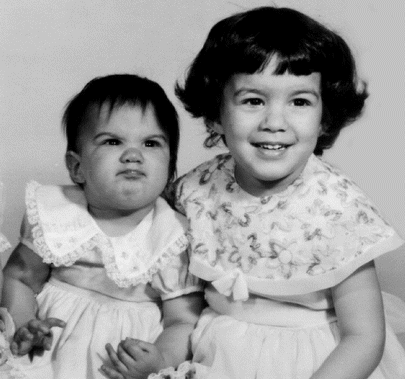
Order a little sister, then order her about.
Ellen Klages
Nanny says that I am spoiled. It comes from being an only child, and not having to share holidays or cakes and always getting to sit by the window. If I had a little brother or sister, I would learn responsibility. More work for her, she sighs, but she is only thinking of my character. Thinking about me is Nanny’s job.Of course, Mother is far too busy to have a baby right now, what with the Henderson case and all. (When I have supper with her, on Wednesdays, she talks about nothing but the Henderson case.) So Nanny has arranged for a nice lady to plant Mother’s egg and do all the messy parts, then give the baby to us when it’s done."What would you like," Nanny asks me over cocoa. "A brother or a sister?"I have to think for a moment, but only a little, because a brother would be a pest and get into my best things, like Courtney Taylor’s brother Robby, who programmed her mobilephone to ring with a nasty farting sound. A sister is someone I can be the boss of."A sister, please," I say in my sweet voice. Nanny loves my sweet voice.Nanny touches a box on the wallscreen, and it glows bright pink."Birthday?" she asks, her finger not quite touching the screen, but ready.My birthday is in June. "October," I say after a minute, because I’ve had to count in my head, so her party won’t get in the way of Christmas, either."Excellent," says Nanny. "We can place our order today." She taps her finger on the screen. That box glows red."What else can we pick?" There are a lot of boxes. I finish my cocoa and stand right next to Nanny, who smells like Vermont.A nice cool green smell.She begins to read to me, scrolling slowly down. "Hair colour?" "Brown." Mine is honey blond."Eyes?" Mine are blue, so brown again. "Intelligence?" I have to think about that. I don’t want a sister who’s stupid, but if she’s smarter than me, she will be difficult to boss."Above average," Nanny decides. "Good at maths?" Hmm. I’m in second grade, and we’re doing the times tables. That could be useful. But it probably isn’t something she’ll be able to do right away. So I shrug, which is a mistake, because Nanny is very strict about manners and posture and I have to listen to a lecture before she will tap the bottom of the screen and scroll to the next page of baby parts.This page is less interesting because the words are very long and I don’t know what theymean. Bioimmunity. Cholesterol. Neuromuscular. I stare at the screen with my eyes very wide so that I don’t yawn out loud. On the side of the screen is a list, like the menu on the Emirate of Toys site, which I used by myself last year for my Christmas wants. The baby list is not very long. Babies only come in about six colours —we’re getting one that matches Mother and me. Humans are a lot less interesting than Legos or iBots. Nanny reads me all the diseases you can ask your baby not to have. Most of them are options, she says, which means we have to pay more. But I think we should pick them all, because a sick sister is not a good thing. Angela Xhobi’s sister has asthma,because she was made the old-fashioned way, without a menu, and she gets all the attention. I wouldn’t like that at all. Nanny takes a breath for another lecture, but I am saved when the iVid sings the Phone Call Song. Nanny sighs again and when she says, "Connect," I see that it’s her mother, who calls every afternoon. Mrs Nanny is quite deaf, even with her implants, so Nanny taps SAVE on the babyscreen and goes downstairs where she can shout without me hearing all the words."Little pitchers," she says to her mother as she greys the upstairs iVid. I don’t know what that means. I slump back into my chair, because Nanny isn’t here to tell me not to, and because she will be gone a long time. Her mother always has a lot to say. I stare at all the diseases, and then I see a betterword at the bottom of thescreen. PETS. We don’t harbour animals, because Nanny is allergic.(She was made the old-fashioned way, too.) But I’d like to see what we could have. I touch the screen to scrolldown for more pets, and a Bubble Man appears, to tell me about a special offer. His picture seems to come out of the wall and stand right in front of me. "Jellyfish DNA on sale," the Bubble Man says. He takes off his top hat, pulls a rabbit out of it, and holds it out towards me. The rabbit’s fur glows a soft, bright green."Wow," I say. "Bioluminescence, 50% off. Today only. Touch Box 306a to order!" He steps back into the screen and disappears with a little picture of smoke.It only takes me a minute to find Box306a and tap it to red. Then I SAVE and scroll back up to the disease boxes. It is good to leave things just the way you found them.I sit very straight in my chair, humming,because I know a secret. Once I have mybaby sister, I will never need my nightlight again. Nanny will be so proud.
Ellen Klages won a Nebula Award in 2005 for her story Basement Magic.
Abonați-vă la:
Postări (Atom)